Evidence of the Impacts of Pharmaceuticals on Aquatic Animal Behaviour (EIPAAB): a systematic map and open access database
Overview
This webpage hosts the ‘Evidence of the Impacts of Pharmaceuticals on Aquatic Animal Behaviour’ (EIPAAB; pronounced EIP-AAB) database produced by the systematic map project (pre-print DOI: https://doi.org/10.32942/X2NG9R). This multi-year project systematically collated all available evidence on the impacts of pharmaceuticals on the behaviour of aquatic organisms and extracted key metadata. The database and associated publication are open-assess and can be downloaded with the link below.
Before using the database, we recommend you read the associated article (pre-print DOI: https://doi.org/10.32942/X2NG9R), visit the project GitHub repository (HERE) and download the summary R script. You can also view the summary script as an interactive page (HERE). The READ-ME file explains what each column is, how it was extracted, what structure it has, and at what level it applies (e.g. article or species level).
Sharing/accessing information
- Licenses/restrictions placed on the data: CC-BY 4.0
- Recommended citation for the publication associated with this data:
Martin, JM, Michelangeli, M, Bertram, MG, Blanchfield, PJ, Brand, JA, Brodin, T, Brooks, B, Cerveny, D, Fergusson, KN, Lagisz, M, Lovin, LM, Ligocki, IY, Nakagawa, S, Ozeki, S, Sandoval-Herrera, N, Kendall, S, Sundin, J, Tan, H, Thor´e, E, Wong, BBM, McCallum, ES, (2024) Evidence of the Impacts of Pharmaceuticals on aquatic animal behaviour (EIPAAB): a systematic map and open access database. EcoEvoRxiv https://doi.org/10.32942/X2NG9R
- Recommended citation for this dataset:
Martin, JM, Michelangeli, M, Bertram, MG, Blanchfield, PJ, Brand, JA, Brodin, T, Brooks, B, Cerveny, D, Fergusson, KN, Lagisz, M, Lovin, LM, Ligocki, IY, Nakagawa, S, Ozeki, S, Sandoval-Herrera, N, Kendall, S, Sundin, J, Tan, H, Thor´e, E, Wong, BBM, McCallum, ES, (2024) EIPAAB database, https://doi.org/10.17605/OSF.IO/ATWY6
Download
Summary
We identified and screened 5,988 articles, of which 901 were included in the final EIPAAB database, representing 1,739 species-by-compound combinations. The database includes data collected over 48 years (1974–2022), with most articles having an environmental focus (510) and fewer relating to medical and basic research topics (233 and 158, respectively). The EIPAAB database includes 173 distinct species representing 8 phyla and 21 classes. Ray-finned fishes were by far the most common clade (at 75% of the evidence base). The database also includes 426 distinct pharmaceutical compounds; the most frequently investigated groups were antidepressants (28%), antiepileptics (11%), and anxiolytics (10%). The impacts of pharmaceuticals on locomotion and boldness/anxiety behaviours were most assessed out of the 10 broad behavioural categories assigned in the database (62 sub-categories in total). Generally, we detected poor reporting and/or compliance with several of our study validity criteria, including the use of experimental blinding, randomisation, reporting of compound details, and exposure concentration verification.
Our systematic map revealed a rapid increase in this research area over the past 15 years. Within this growing field of research, we highlight multiple areas that are now suitable for quantitative synthesis and areas where evidence is lacking. We also highlight some obvious pitfalls in method reporting and practice, and stress that more detailed reporting would facilitate the use of behavioural endpoints in chemical regulation, and is required to improve the overall replicability of this research area. The EIPAAB database generated here can be used as a tool for closing these knowledge and methodological gaps in the future.
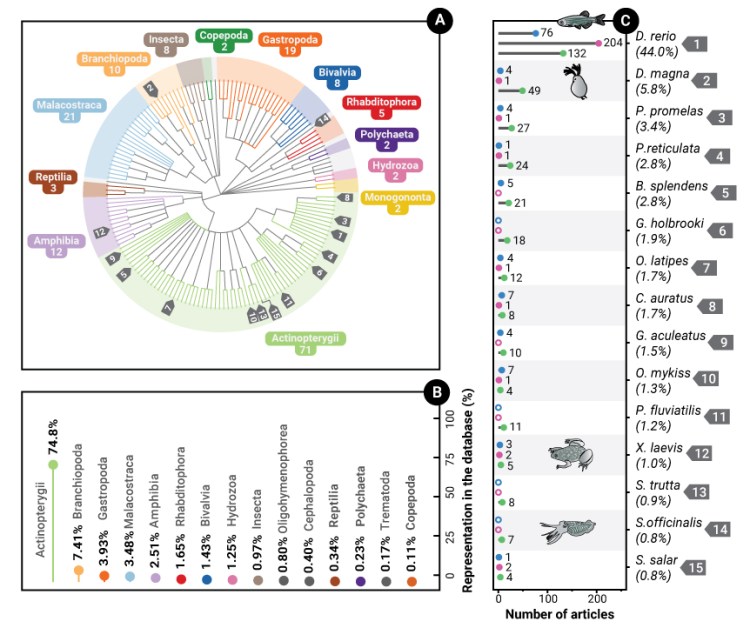
See more summary information in the associated article (HERE) and in the summary script (HERE)
 Dr Jake M. Martin